
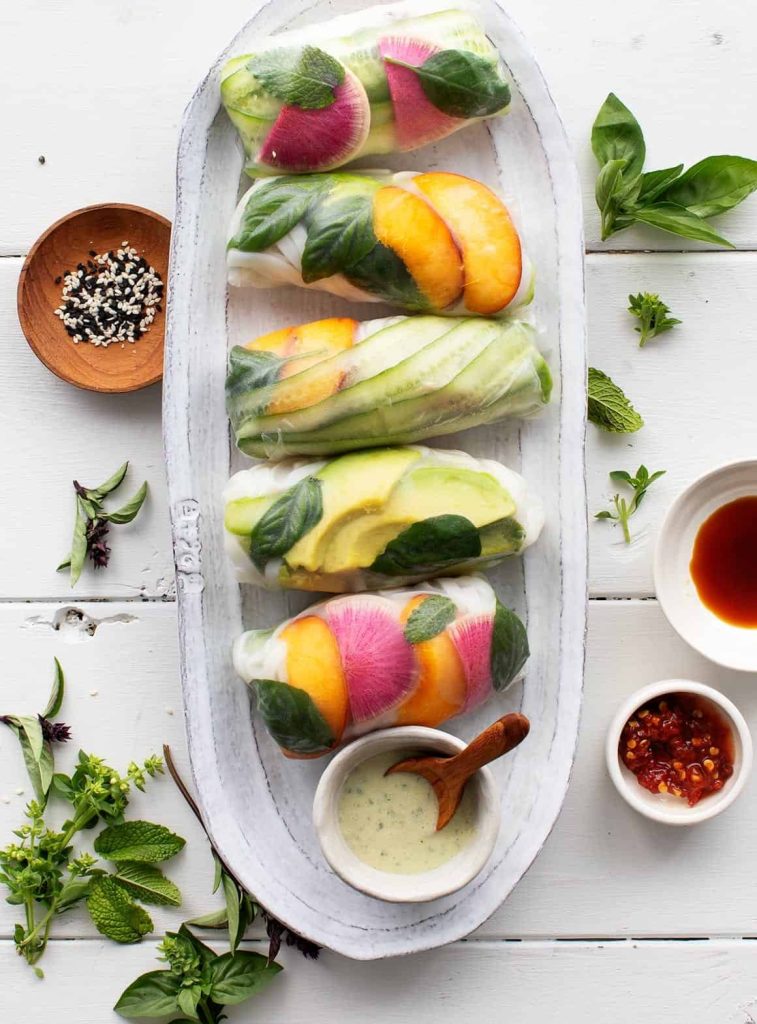
There is a category of food that exists at the intersection of beautiful and delicious — food that looks like someone spent a great deal of time on it when they actually did not, and that tastes light and vibrant and like something you want to eat slowly. Vietnamese-style fresh summer rolls sit squarely in that category.
These mango and avocado summer rolls are raw, refreshing, and visually striking. The rice paper wrapper is translucent, allowing the vivid colours of the filling — the warm orange of the mango, the pale green of the avocado, the deep purple of the red cabbage — to show through like stained glass. They are the kind of dish that gets photographed before it gets eaten, and that still tastes excellent once the photography is done.
The peanut dipping sauce is the companion these rolls deserve: rich, slightly spicy, and assertive enough to complement the delicate filling without overwhelming it.
A Note on Rice Paper Wrappers
Rice paper wrappers require a brief soak in warm water to become pliable — typically 15 to 20 seconds in water that is warm but not boiling. Under-soaked wrappers are brittle and crack during rolling. Over-soaked wrappers become sticky and tear. The ideal is a wrapper that is just pliable — still slightly stiff when removed from the water, finishing its softening process as you lay it flat and begin filling it.
The technique is learned rather than read, and the first roll is almost always the least elegant. By the fourth, you will have found your rhythm.
Ingredients (Makes 10–12 rolls)
For the rolls:
- 10–12 round rice paper wrappers (22cm diameter)
- 2 ripe mangoes, peeled and julienned or thinly sliced
- 2 ripe avocados, sliced
- ½ head red cabbage, very finely shredded
- 2 medium carrots, julienned or grated
- 1 cucumber, julienned (seeds removed)
- 100g rice vermicelli noodles, cooked and cooled
- A large handful of fresh mint leaves
- A large handful of fresh coriander
- A large handful of fresh Thai basil (optional but excellent)
- 1 red chilli, thinly sliced (optional)
- 1 lime, for squeezing
For the peanut dipping sauce:
- 4 tablespoons natural peanut butter
- 2 tablespoons soy sauce or tamari
- 2 tablespoons fresh lime juice
- 1 tablespoon maple syrup or coconut sugar
- 1 tablespoon rice vinegar
- 1 teaspoon sesame oil
- 2 garlic cloves, finely grated
- 1 teaspoon fresh ginger, grated
- 1 teaspoon chilli sauce or sambal oelek
- 4–6 tablespoons warm water (to thin)
Method
Step 1: Prepare All Fillings
Before you begin rolling, have every element of the filling prepared, organised, and within reach. Once you start working with a soaked rice paper wrapper, speed matters — you want to fill and roll without stopping to chop or prepare. Set out the mango, avocado, cabbage, carrot, cucumber, noodles, and herbs in small portions on a large chopping board or tray.
Step 2: Make the Peanut Sauce
In a bowl, whisk together the peanut butter, soy sauce, lime juice, maple syrup, rice vinegar, sesame oil, garlic, ginger, and chilli sauce. Add warm water, one tablespoon at a time, until the sauce is smooth and pourable. It should coat the back of a spoon but flow freely when lifted. Taste and adjust — more lime if it needs brightness, more soy if flat, more maple syrup if too sharp. Set aside.
Step 3: Soak and Roll
Fill a large, shallow bowl or roasting tray with warm water. Submerge a rice paper wrapper for 15 to 20 seconds until just pliable. Remove carefully and lay flat on a clean, damp surface (a slightly damp tea towel or silicone mat works well — not a dry chopping board, which causes sticking).
Layer the fillings in the lower third of the wrapper: a small bundle of vermicelli noodles, a few slices of mango and avocado, a pinch of shredded cabbage and carrot, a few sticks of cucumber, mint leaves, coriander, and Thai basil. Do not overfill — the roll should close comfortably.
Fold the bottom of the wrapper up over the filling. Fold in the two sides. Roll forward firmly but gently until you have a neat cylinder. The rice paper will stick to itself. Place seam-side down on a plate. Repeat with remaining wrappers.
Step 4: Serve
Serve immediately with the peanut dipping sauce. If making ahead, lay the rolls on a parchment-lined tray, cover with a damp tea towel, and refrigerate for up to three hours. Beyond that, the wrappers begin to dry and crack.
Filling Variations
Summer rolls are one of the most adaptable preparations in any kitchen. Once you are comfortable with the technique, the filling becomes an exercise in creativity:
Tropical: Papaya, pineapple, and coconut strips with fresh mint and lime zest.
Protein-rich: Add strips of marinated and pan-fried tofu or tempeh alongside the vegetables.
Korean-inspired: Replace the peanut sauce with a gochujang-soy dipping sauce. Add kimchi, thinly sliced cucumber, and sesame seeds to the filling.
Mediterranean: Fill with hummus, roasted red peppers, cucumber, olives, and fresh parsley. Serve with a tahini dipping sauce.
Nutrition
Fresh summer rolls are among the most nutritionally efficient handheld foods available. Each roll provides a meaningful portion of vitamins A and C from the vegetables, healthy monounsaturated fats from the avocado, and plant-based protein and healthy fats from the peanut sauce. Mango contributes beta-carotene, vitamin C, and natural sugars for immediate energy.
Rice paper wrappers are naturally gluten-free, low in calories, and easy to digest. This makes these rolls a genuinely accessible option for those managing a range of dietary requirements.
A Final Note
What I love most about this recipe is the moment of assembly — the meditative repetition of soaking, filling, rolling. It is the kind of cooking that slows you down in the best way, requiring enough attention to pull you fully into the present moment.
Make these for a summer lunch, a light dinner, or a visually impressive starter for guests. Serve with additional lime wedges and a small dish of soy sauce alongside the peanut sauce.
They are one of those rare dishes that are as enjoyable to make as they are to eat.
Explore more fresh and vibrant plant-based recipes in our Website.