
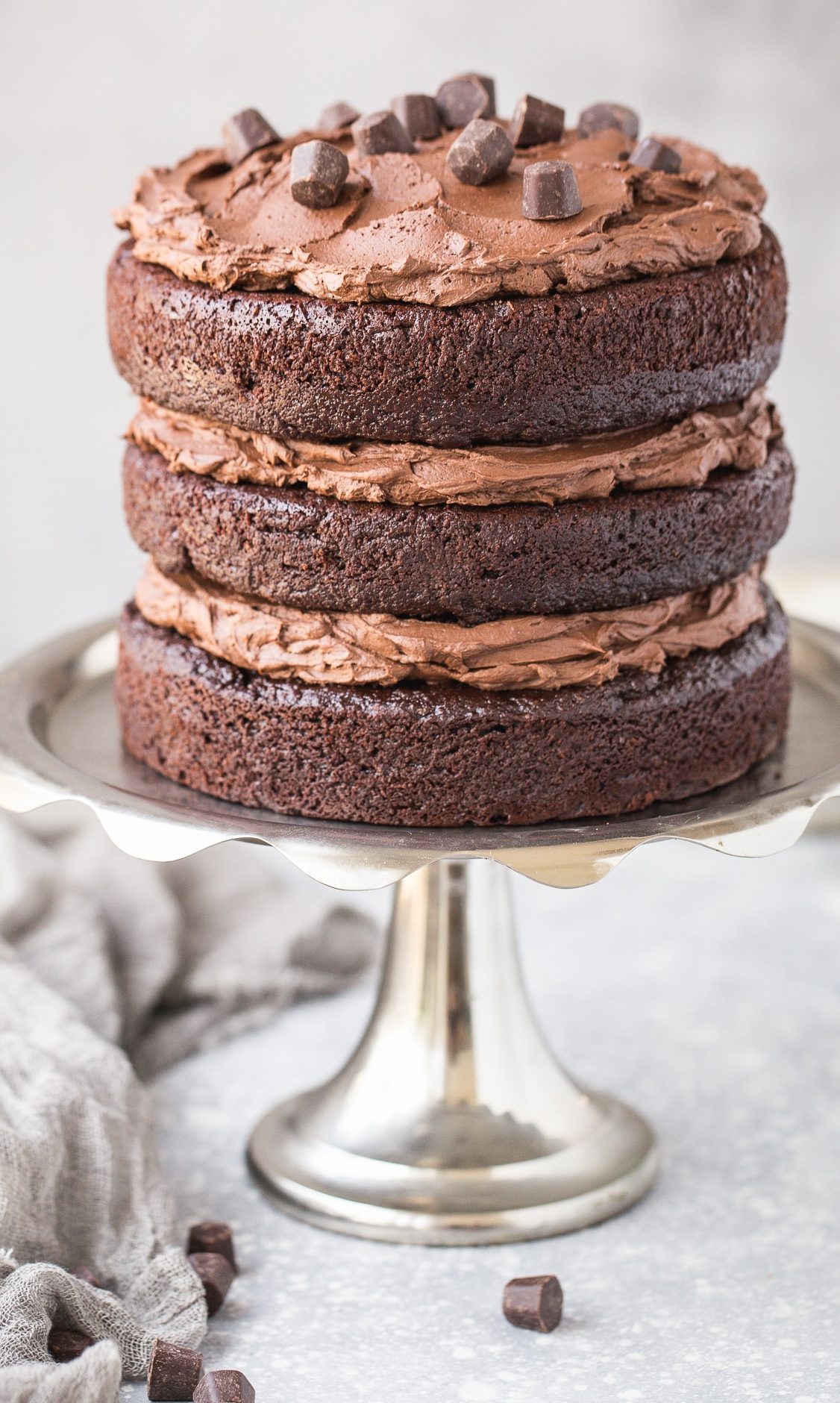
I want to address something directly before we begin: this is not a healthy chocolate cake. It is not a cake that has been cleaned up, lightened, or compromised in the name of wellness. It is a deeply, unapologetically indulgent chocolate cake — rich, moist, intensely chocolatey, and covered in a ganache-style frosting that is silky and luxurious and, yes, entirely plant-based.
I make no apologies for this. Vegan baking deserves its celebrations, and this cake is one of them.
What surprises most people who try this recipe — including devoted bakers who have never made a vegan cake before — is how genuinely excellent the texture is. Moist without being dense, soft without being fragile, with a crumb that holds together beautifully when sliced and collapses into something deeply satisfying when eaten. This is not a cake with compromises. It is simply a very good chocolate cake.
The secret is understanding what eggs and dairy actually do in a conventional chocolate cake — and then replicating those functions with ingredients that also happen to be plant-based.
The Science Behind Vegan Baking
In a conventional chocolate cake, eggs serve three main purposes: they bind the batter, they add moisture, and they contribute to structure through their protein content. Dairy milk adds fat and liquid. Butter contributes flavour and helps create a tender crumb.
In this recipe, a combination of ingredients replicates each of those functions:
Flaxseed egg: One tablespoon of ground flaxseed combined with three tablespoons of water creates a gel after five minutes that behaves remarkably similarly to a whole egg in terms of binding.
Vegan buttermilk: Plant milk combined with apple cider vinegar curdles slightly and mimics the role of buttermilk in activating the leavening agents and tenderising the crumb.
Oil: Neutral oil produces a moister crumb than butter in chocolate cake because it remains liquid at room temperature, whereas butter solidifies and can cause the crumb to dry out.
Boiling water: This is the most counterintuitive ingredient in the recipe, but it is also the most important. Added at the end of mixing, hot water blooms the cocoa powder — releasing its full flavour potential — and produces a thin, pourable batter that bakes into an extraordinarily moist cake.
Ingredients (Serves 12–16)
For the cake:
- 300g plain flour
- 300g caster sugar or fine coconut sugar
- 80g high-quality cocoa powder (Dutch-processed preferred)
- 2 teaspoons baking powder
- 2 teaspoons bicarbonate of soda
- 1 teaspoon fine salt
- 2 tablespoons ground flaxseed mixed with 6 tablespoons water (2 flax eggs, rested 10 mins)
- 240ml unsweetened oat milk or soy milk
- 2 tablespoons apple cider vinegar
- 160ml neutral oil
- 2 teaspoons vanilla extract
- 240ml boiling water
For the chocolate ganache frosting:
- 200g good-quality dark chocolate (70% cocoa, vegan)
- 200ml full-fat coconut cream (chilled overnight)
- 2 tablespoons maple syrup
- 1 teaspoon vanilla extract
- A pinch of salt
Method
Step 1: Prepare
Preheat the oven to 180°C (160°C fan). Grease two 20cm round cake tins and line the bases with baking parchment. Mix the ground flaxseed with the water and set aside for at least 10 minutes to gel. Combine the oat milk and apple cider vinegar, stir, and set aside for five minutes to create the vegan buttermilk.
Step 2: Mix Dry Ingredients
In a large bowl, sift together the flour, cocoa powder, baking powder, bicarbonate of soda, salt, and sugar. Whisk to combine — ensuring the leavening agents are evenly distributed throughout the flour is important for an even rise.
Step 3: Combine Wet Ingredients
In a separate bowl or jug, whisk together the flax eggs, vegan buttermilk, oil, and vanilla extract until well combined.
Step 4: Combine
Pour the wet ingredients into the dry ingredients and mix with a spatula or whisk until just combined. Then — and this is the crucial step — pour in the boiling water and mix until the batter is smooth. It will be very thin and liquid; this is correct and expected. Do not be alarmed.
Step 5: Bake
Divide the batter evenly between the two prepared tins. Bake for 30 to 35 minutes until a skewer inserted into the centre comes out clean. The cakes will rise significantly and then settle slightly as they cool — this is normal.
Allow to cool in the tins for 15 minutes, then turn out onto a wire rack and leave to cool completely before frosting. A warm cake will melt the frosting; patience here is essential.
Step 6: Make the Ganache Frosting
Finely chop the dark chocolate and place in a heatproof bowl. Heat the coconut cream in a small saucepan over medium heat until it just begins to simmer — do not boil. Pour the hot cream over the chopped chocolate and leave for two minutes without stirring. Then stir from the centre outward in slow, deliberate circles until the ganache is completely smooth and glossy.
Add the maple syrup, vanilla extract, and salt. Stir to combine. Allow the ganache to cool at room temperature until it reaches a spreadable consistency — roughly 30 to 45 minutes. For a thicker frosting, refrigerate for 20 minutes, checking every 10 minutes.
Step 7: Assemble
Place one cake layer on a serving plate. Spread a generous layer of ganache frosting over the top. Place the second layer on top and frost the top and sides. For a polished finish, refrigerate the assembled cake for 20 minutes after the initial frosting — this sets the first layer — then add a final coating.
Serving Suggestions
This cake is complete as it is, but a scattering of fresh raspberries, a dusting of cocoa powder, or a handful of roasted hazelnuts over the top adds visual appeal and contrasting texture. A small drizzle of extra ganache warmed to pouring consistency creates a dramatic effect.
Serve at room temperature — cold chocolate cake loses much of its flavour and the ganache becomes firm and waxy.
Storage
Store the frosted cake in an airtight container at room temperature for up to three days, or refrigerate for up to five days. Remove from the refrigerator at least 30 minutes before serving to allow the ganache to soften to its best texture. Individual slices freeze well — wrap in parchment and store in a freezer bag for up to two months.
A Note on Cocoa Powder
The quality of the cocoa powder matters enormously in this recipe. Dutch-processed cocoa has been treated with alkali to reduce its natural acidity — the result is a deeper, darker colour and a smoother, less bitter flavour than natural cocoa. It is the better choice for a rich, deeply chocolatey cake.
Natural cocoa can also be used, but reduce the bicarbonate of soda by half, as natural cocoa is more acidic and will over-react with the leavening.
Final Thoughts
This cake proves, perhaps more eloquently than any argument could, that plant-based cooking is not a culinary concession. It is not a second-tier option for those who have given something up. It is simply another way of cooking — one that is capable of producing food that is extraordinary on its own terms.
Bring this cake to a birthday. Serve it at a dinner party without mentioning that it is vegan. Notice the reactions.
Then tell them. That part is always worth it.
Find more nourishing plant-based recipes in our Website.